APIs, Explained Like a Border Checkpoint
What APIs actually are, how they're built, the types, the lifecycle, why they matter now, and the parts most explainers skip.
You called a dozen APIs before you finished your coffee this morning.
Your phone’s lock screen pulled the weather. Your bank app checked a balance. A tap-to-pay bought the coffee, which quietly touched a card network, a fraud model, and a merchant ledger, three or four separate systems that have never met, cooperating in under a second. None of them share a database. None of them trust each other by default. They cooperate anyway, because each one exposes an API: a defined doorway through which the outside world is allowed to ask for things.
This post is a tour of that doorway: what it is, how one gets built, the shapes they come in, how they live and die, and why the whole idea suddenly matters more than it did a year ago. I’ll skip the tired restaurant metaphor. A better mental model is a border checkpoint.
What an API actually is
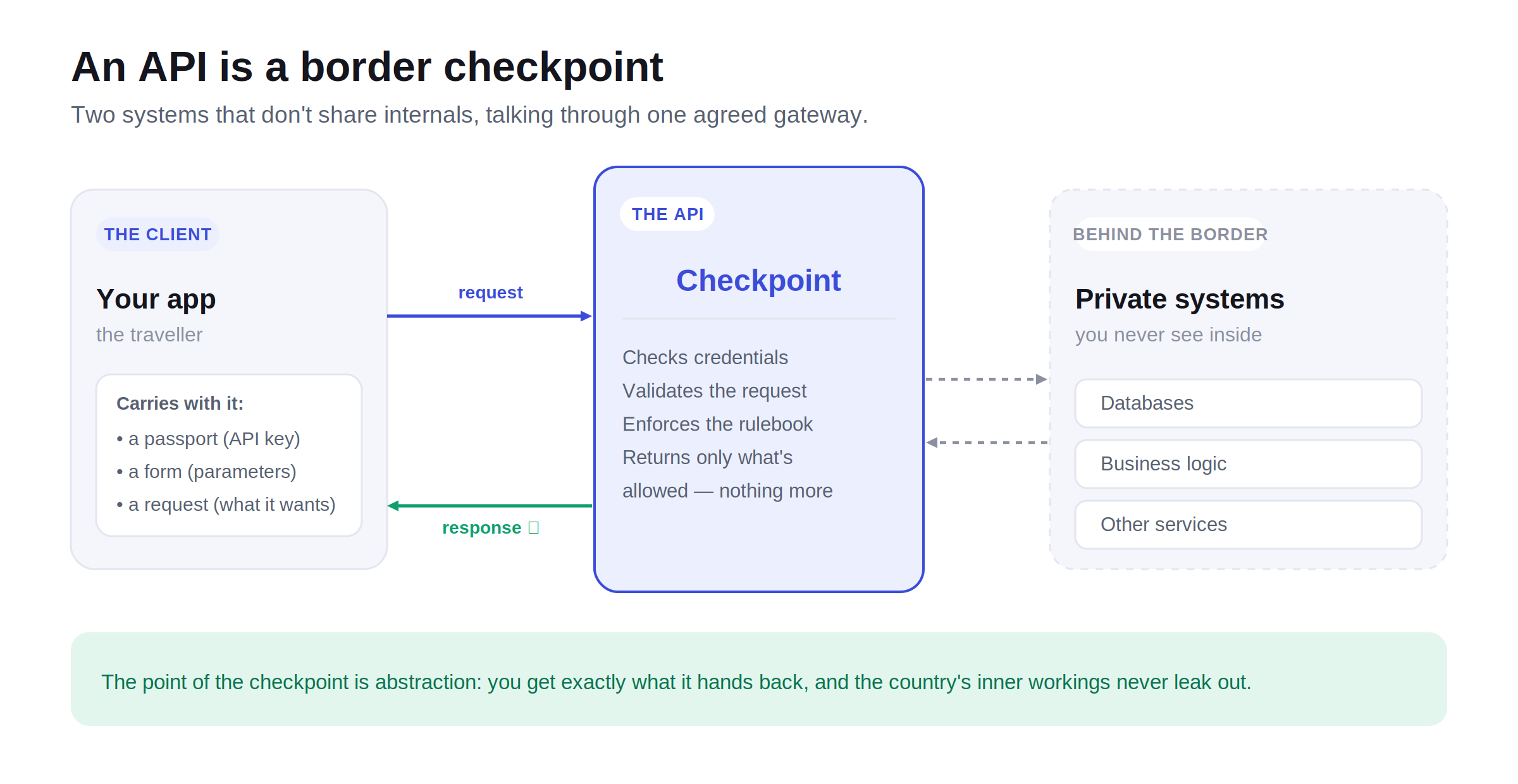
The acronym stands for Application Programming Interface, but the only word worth keeping is interface. An API is the agreed surface where two pieces of software meet. Everything behind it (the databases, the business logic, the messy internal wiring) stays hidden. You interact with the surface, never the machinery.
A border checkpoint works the same way. You (the traveller) arrive with a passport and a filled-out form. The officer checks your credentials, validates the request against a rulebook, and either waves you through with exactly what you asked for or turns you away. You never walk into the country’s interior ministry and rummage through its filing cabinets. You get precisely what the checkpoint hands back, and nothing about the inner workings leaks out.
That property has a name: abstraction. It’s the reason a company can rebuild its entire backend over a weekend and every app calling its API keeps working, so long as the checkpoint’s rules (the contract) stay the same. The contract is the real product. The code behind it is just an implementation detail that’s allowed to change.
Anatomy of a single call
Zoom into one crossing and you’ll find the same handful of parts every time: a request goes in, a response comes back, and both are structured so a machine can read them without guessing.
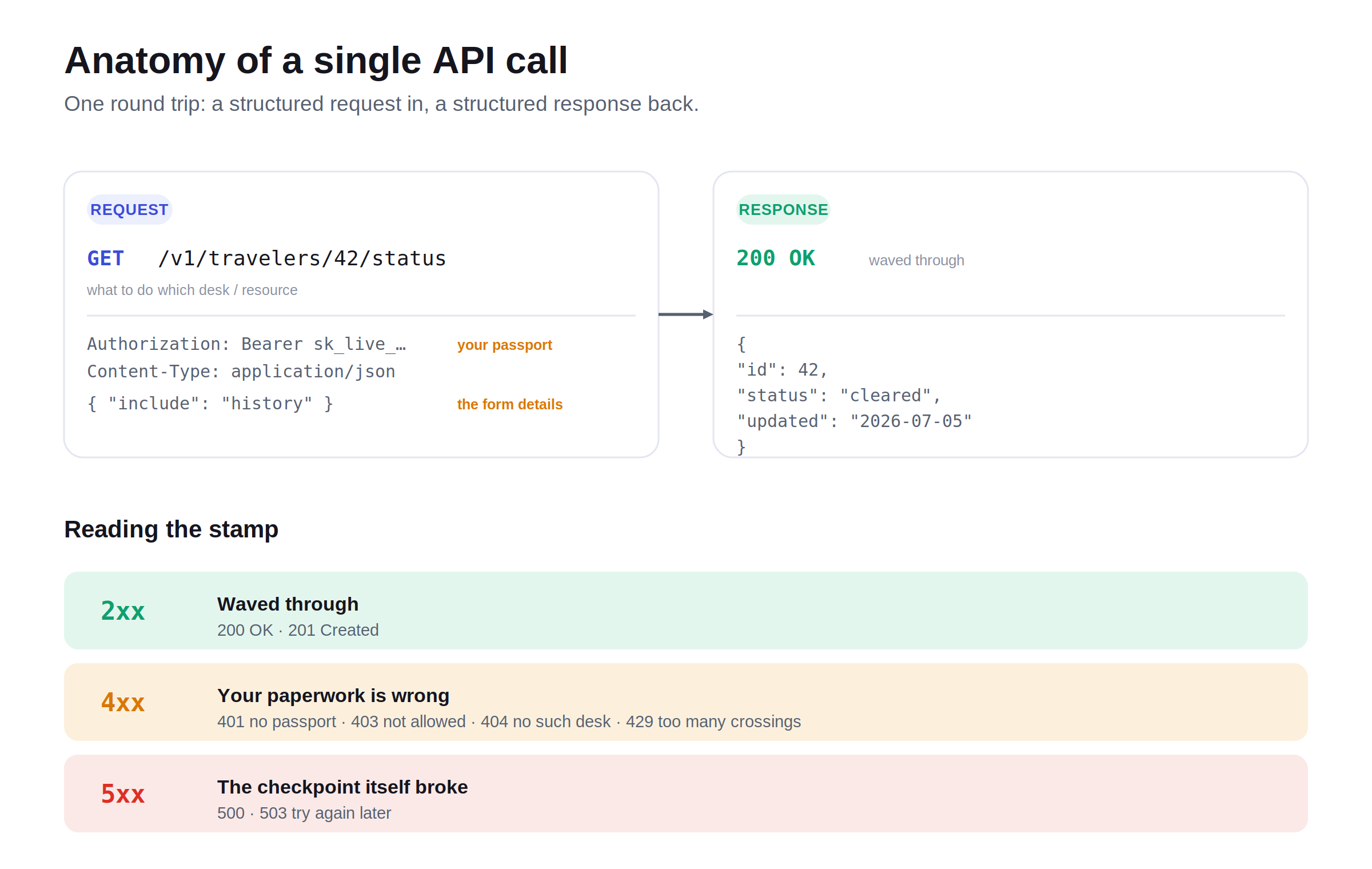
A typical request looks like this:
GET /v1/travelers/42/status
Authorization: Bearer sk_live_…
Content-Type: application/json

{ "include": "history" }
Four parts, each with a checkpoint equivalent:
- Method (
GET,POST,DELETE…) is what you want to do: look, create, remove. - Endpoint (
/v1/travelers/42/status) is which desk you’re standing at. - Headers (
Authorization: …) are your passport. This is where the key that proves who you are travels. - Body is the form details: the specifics of your request.
The response comes back with a status code, and learning to read the stamp is half of working with APIs:
- 2xx: waved through.
200 OK,201 Created. It worked. - 4xx: your paperwork is wrong.
401(no valid passport),403(passport fine, but you’re not allowed here),404(no such desk),429(you’ve crossed too many times, slow down). - 5xx: the checkpoint itself broke.
500,503. Not your fault; try again later.
The genius of this scheme is that a 4xx tells you to fix your request and a 5xx tells you to stop trying and wait. That single distinction saves an enormous amount of debugging.
Every API is two choices at once
“What type of API is it?” is a slightly malformed question, because an API is really two choices made independently: a style (how it talks) and an audience (who’s allowed to talk to it).
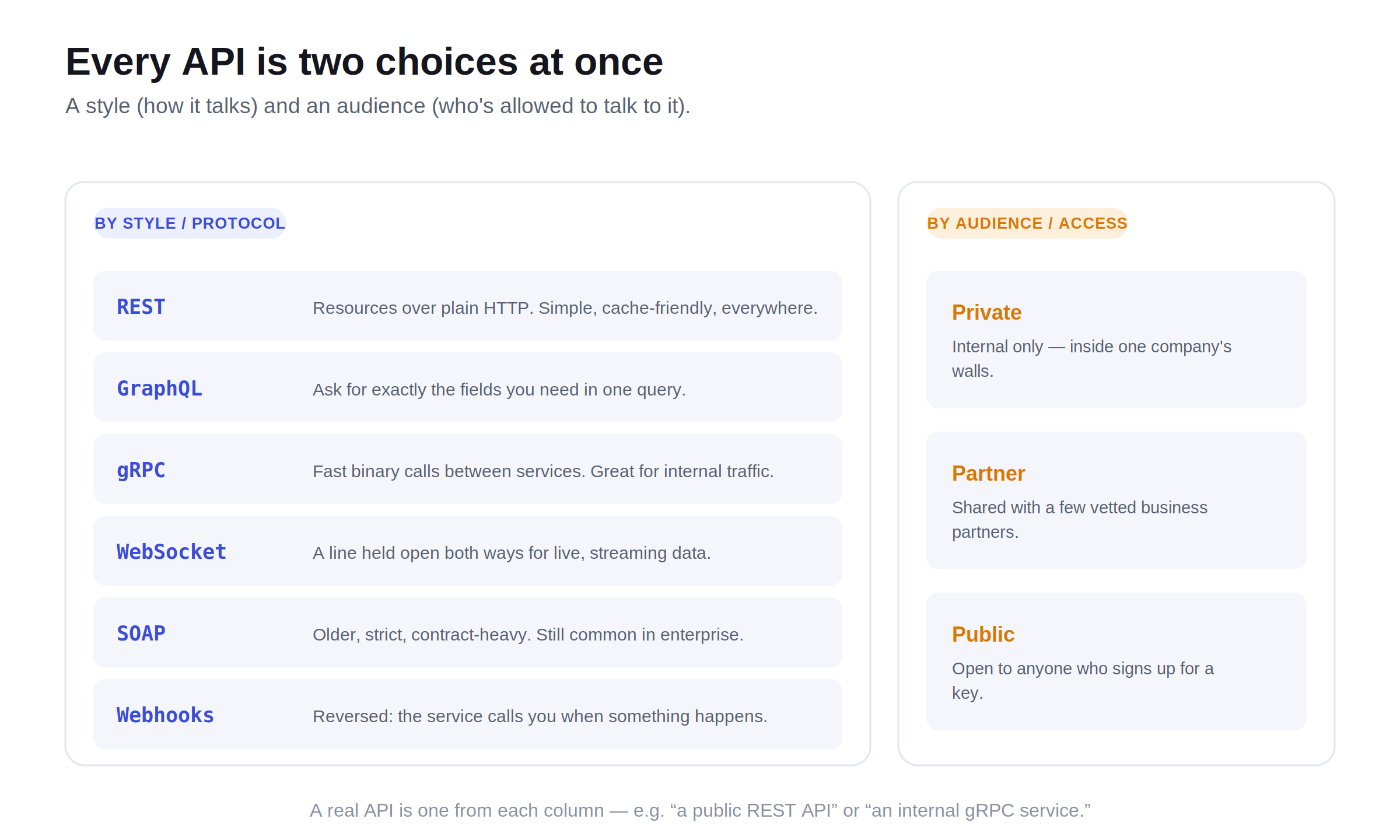
On the style axis, the ones worth knowing:
- REST: resources addressed over plain HTTP. Simple, cacheable, everywhere. The safe default.
- GraphQL: you ask for exactly the fields you want in a single query, which kills the “too much data / too many round trips” tradeoff REST can force.
- gRPC: fast binary calls, ideal for services talking to other services inside your own walls where speed beats human-readability.
- WebSocket: a line held open in both directions, for anything live: chat, prices, multiplayer.
- SOAP: older, strict, contract-heavy. Rare in new consumer products, still load-bearing in banking and enterprise.
- Webhooks: the direction reversed. Instead of you asking repeatedly, the service calls you the moment something happens. This is how you avoid polling an endpoint every five seconds like an anxious child asking “are we there yet?”
On the audience axis: private (internal only), partner (shared with a few vetted businesses), and public (open to anyone with a key). A real API is always one from each column: “a public REST API,” “an internal gRPC service.” The two choices are orthogonal, and confusing them is a common source of muddled architecture conversations.
How an API is actually built
The instinct is to write code first and document it later. Mature teams invert that: they design the contract first, usually as an OpenAPI spec, agree on it, and only then build behind it. The spec becomes a single source of truth that generates docs, client libraries, and test mocks, and lets the frontend and backend teams work in parallel against the same promise.
At runtime, most of the guarding happens in one place: an API gateway.
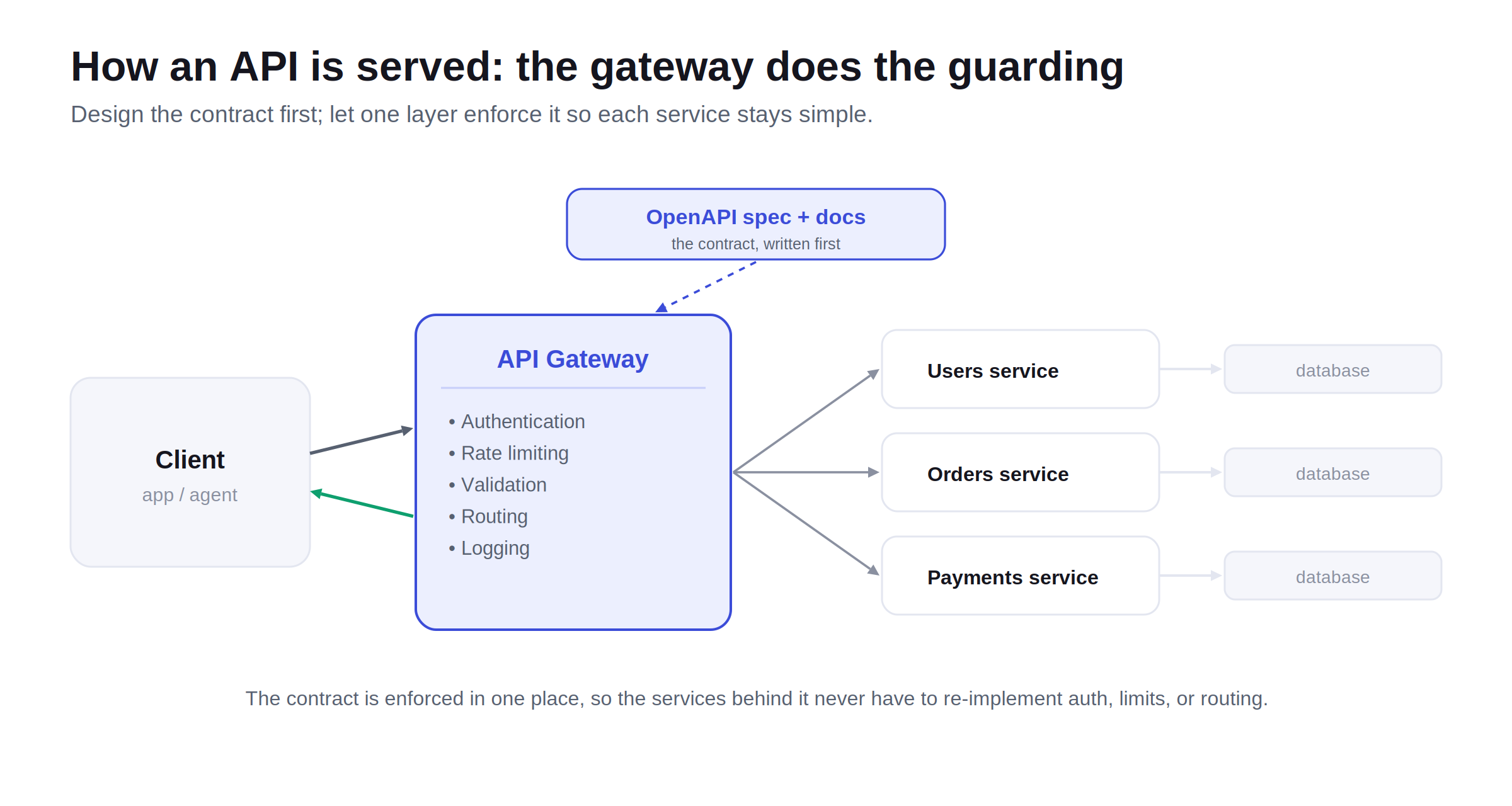
The gateway is the checkpoint booth made literal. It authenticates the caller, enforces rate limits, validates the request shape, routes it to whichever internal service owns that resource, and logs the whole thing. Centralizing these cross-cutting concerns means the services behind it don’t each have to reinvent auth and throttling. They can stay small and focused on their one job. Change the rules once, at the gateway, and every service inherits them.
An API is a product, not a project
The most expensive mistake teams make is treating an API as something you finish. You don’t. Once other people build on your doorway, you’ve made a promise, and the work of keeping that promise outlasts the launch by years.
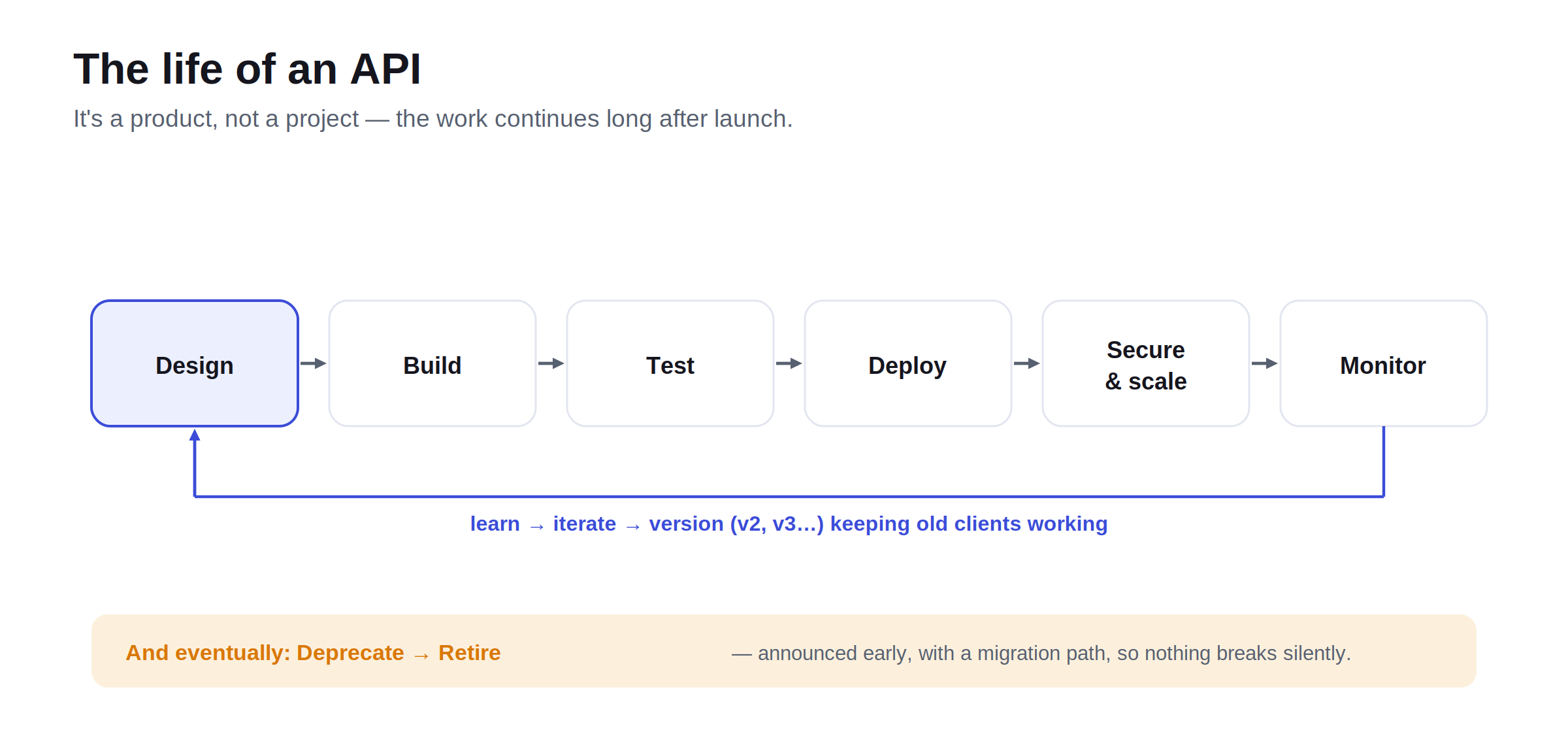
The stages are unremarkable until the last two. Versioning is where discipline shows: when you need to change behavior, you ship a v2 while keeping v1 alive, because somewhere out there a customer’s integration depends on the old contract and will shatter the instant you break it silently. And deprecation is a courtesy, not an event: you announce it early, provide a migration path, and give people runway. An API that changes without warning isn’t a product; it’s a liability with a URL.
Why this matters now more than ever
For most of their history, APIs were a business story: they let companies plug into each other, which turned software into Lego. Stripe made payments a few lines of code. Twilio did it for text messages, Plaid for bank connections. Whole companies now exist as nothing but a well-run API, and the “API economy” is the quiet infrastructure under most of what you use online.
That was already a big deal. Then AI changed who’s doing the calling.
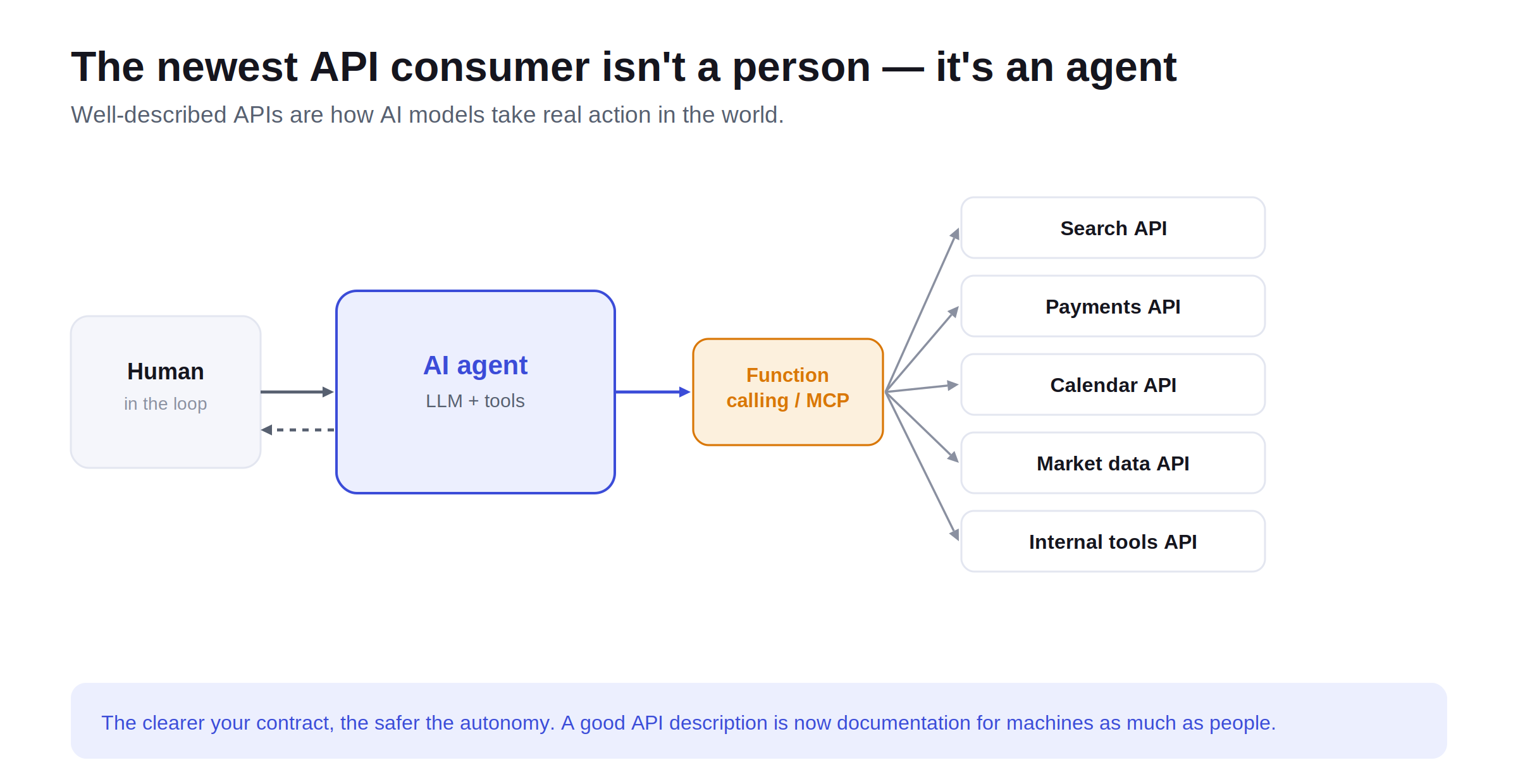
The newest consumer of your API isn’t a person or even a hard-coded program. It’s an AI agent. Through mechanisms like function calling and the Model Context Protocol (MCP), a language model can read what an API offers, decide it needs it, and call it to actually do something: check a calendar, pull market data, move a task, place an order. The model reasons; the API acts.
This puts a new weight on old virtues. A well-described API has always been kind to human developers. Now that same clear description is what lets a model use the tool safely: it’s documentation for machines as much as people. And because agents can act on their own, the human-in-the-loop pattern and tight, read-only or preview-first scopes stop being nice-to-haves and become the difference between a useful assistant and an expensive accident. The clearer your contract, the safer the autonomy you can grant.
The parts most explainers skip
The sections above are the standard tour. Here’s what separates people who use APIs from people who build good ones, the topics that rarely make the intro but decide whether an API is a pleasure or a trap:
- Authentication vs. authorization. Who are you (authN, the passport) and what are you allowed to do (authZ, the visa) are different questions with different failure modes. Conflating them is behind a huge share of breaches.
- The OWASP API Security Top 10. Most API breaches aren’t exotic. They’re broken object-level authorization: a user changing
/orders/42to/orders/43and seeing someone else’s data. Worth reading once, early. - Idempotency. If a payment request times out and the client retries, will the customer be charged twice? A well-designed
POSTaccepts an idempotency key so a retry is safe. This is unglamorous and enormously important. - Rate limiting and pagination. How you protect the service from being overwhelmed, and how you hand back ten million records without collapsing. Both should be in the design from day one, not bolted on after an outage.
- Error design. A good error tells the caller what went wrong and what to do about it, in a consistent shape. Vague errors are how you burn a developer’s afternoon.
- Developer experience (DX). The best API is the one someone can get working in five minutes. Clear docs, sane defaults, honest examples, and a sandbox aren’t decoration. For a public API, DX is the product.
- Observability. You cannot keep a promise you can’t measure. Latency, error rates, and per-endpoint usage are how you find out something’s wrong before your users tell you.
The best APIs are boring
Notice that none of that final list is about clever code. A great API is predictable, well-documented, hard to misuse, and almost forgettable: you plug in, it does exactly what the contract said, and you move on to your actual problem. The checkpoint you remember is the one that lost your paperwork. The good ones you walk through without a second thought.
That’s the whole craft: build a doorway so clear and so reliable that the person, or the model, walking through it never has to think about you at all.
Have thoughts on this? I'd genuinely love to hear them. Find me on X or LinkedIn.
A note: The views here are my own and don't represent my employer or anyone I work with. Everything I write is personal opinion, shared for general informational and educational purposes, and reflects my thinking at the time of writing. It is not professional, financial, legal, or investment advice. Please read posts in full rather than pulling lines out of context, and do your own research before acting on anything.